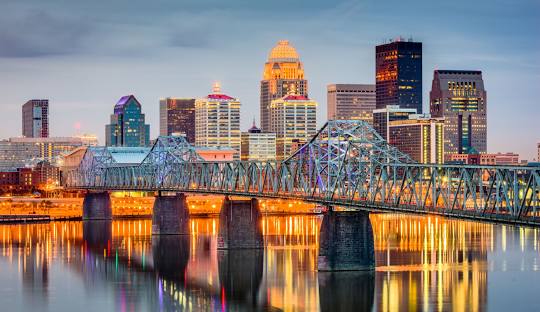
Louisville in the 20th Century: Resilience, Change, and Urban Revival
Posted by on
Throughout the 20th century, Louisville, Kentucky, experienced profound social, economic, and geographic changes. Following the Civil War, freed slaves settled in Little Africa, a thriving neighborhood near today’s Park DuValle, often called “the gateway to the South.” By the 1920s, the area flourished, though it declined between the 1940s and 1950s.
In 1914, Louisville enacted a racially based residential zoning ordinance, modeled after other U.S. cities. The ordinance was challenged by the NAACP in the landmark Buchanan v. Warley case. In 1917, the U.S. Supreme Court struck down the law, ruling it violated the Fourteenth Amendment’s due process clause, a major victory against residential segregation.
During World War I, Louisville hosted Camp Zachary Taylor, one of the nation’s largest training camps, preparing over 150,000 soldiers, including author F. Scott Fitzgerald. Many structures in the Camp Taylor neighborhood today trace their origins to the camp. In 1929, the completion of the Falls of the Ohio lock and dam bolstered industrial growth, attracting 15,000 new residents, about 3% of them Black migrants escaping rural poverty.
Louisville faced natural disasters, including the Great Flood of 1937, when the Ohio River crested at a record 57.15 feet, submerging up to 70% of the city. Thousands were evacuated, 90 people died, and the flood reshaped residential patterns, favoring higher elevation areas. The city later constructed extensive flood walls for protection.
World War II brought industrial growth, as Louisville’s Curtiss-Wright Aircraft plant produced C-46 Commando planes. After the war, the facility was converted to tractor production by International Harvester. By 1950, Louisville’s population was 84.3% white and 15.6% Black, with racial dynamics marked by “polite” segregation, including segregated police patrols.
The 1960s and 1970s saw suburban migration, fueled by new highways and economic shifts, while older industrial neighborhoods declined. In 1974, Louisville suffered a major F4 tornado during the Super Outbreak, destroying hundreds of homes and causing two deaths.
Starting in the 1980s, many urban neighborhoods underwent revitalization, attracting young professionals and college students. Key areas transformed included Bardstown Road/Baxter Avenue, Frankfort Avenue, Old Louisville, and more recently, the East Market District (NuLu). These changes helped Louisville balance its rich historical legacy with a modern, vibrant urban culture.